
Founded in 1790, the nation's capital is a dynamic city with to a wealth of history to match its place in American history.
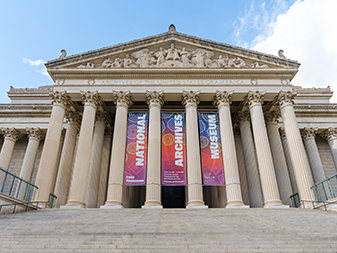
Founded on July 16, 1790, Washington, DC is unique among American cities in that it was established by the Constitution of the United States to serve as the nation’s capital. You can read the actual line at the National Archives. From its beginning, DC has been embroiled in political maneuvering, sectional conflicts and issues of race, national identity, compromise and, of course, power. The District has also developed its own unique personality and vibe thanks to its diverse population.
Like many decisions in American history, the location of the new city was to be a compromise: Alexander Hamilton and northern states wanted the new federal government to assume Revolutionary War debts and Thomas Jefferson and southern states wanted the capital placed in a location friendly to slave-holding agricultural interests.
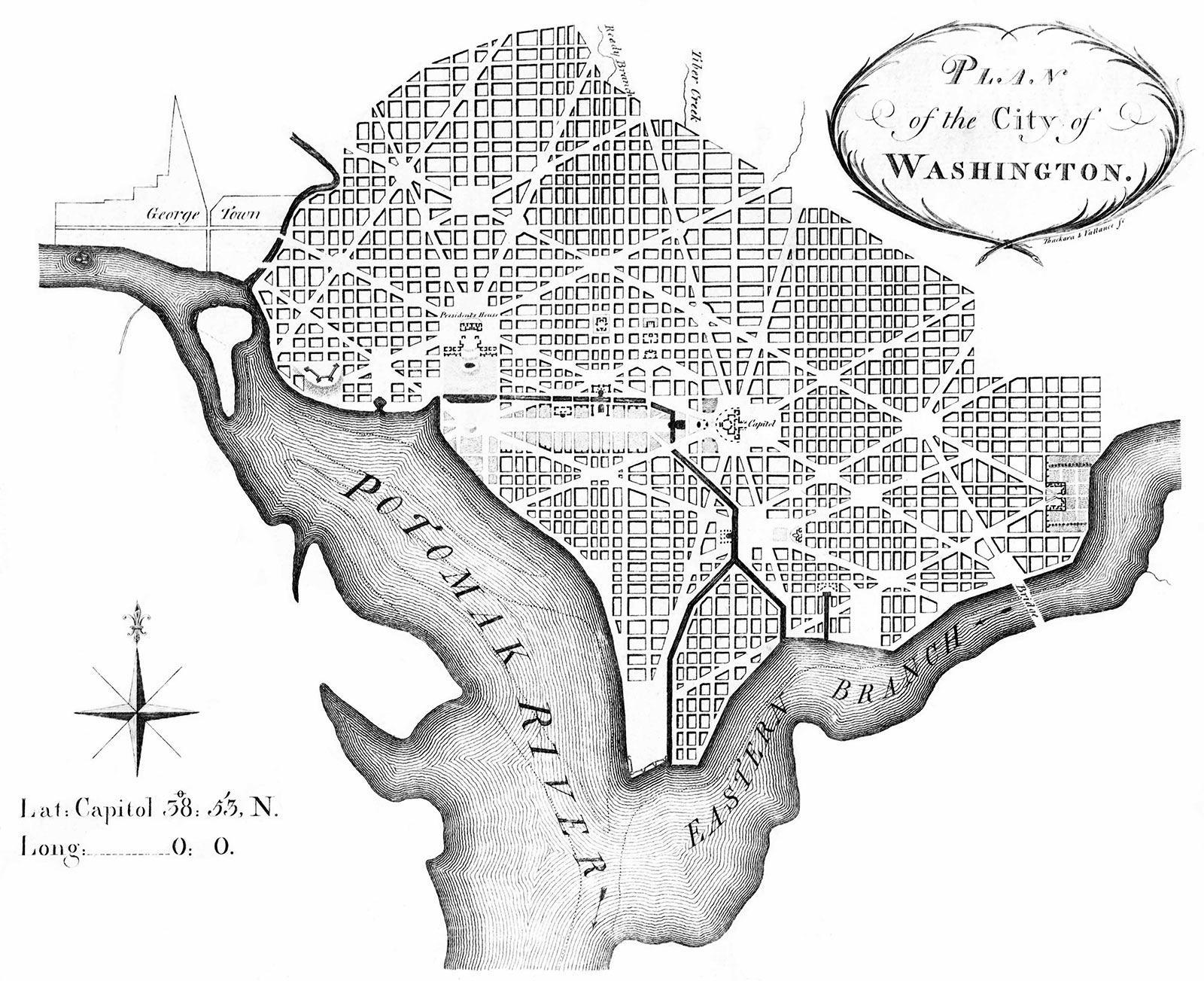
President George Washington chose the exact site along the Potomac and Anacostia Rivers and the city was officially founded in 1790 after both Maryland and Virginia ceded land to this new “district” to be distinct and distinguished from the rest of the states. To design the city, he appointed Pierre Charles L’Enfant, who presented a vision for a bold, modern city featuring grand boulevards (now the streets named for states) and ceremonial spaces reminiscent of another great world capital, L’Enfant’s native Paris. He planned a grid system, at which the center would be the Capitol Building.
Even before coming of age, DC was nearly completely destroyed. During the War of 1812 against Great Britain, enemy forces invaded the city and burned much of it to the ground, including the newly completed White House, the Capitol and the Library of Congress (including all of its books). Thomas Jefferson later replenished the collection by selling off his entire library for $23,950 in 1815.
After the devastation, the city remained small, especially in terms of permanent residents. Soon it would become smaller in physical size as well. In 1847, the portion of the city that had originally belonged to Virginia was retroceded, after the voters of Alexandria elected to leave DC, feeling that they had been left out of development on the other side of the river. You can still see some surviving markers for the District today.
The Civil War increased the city's size. Slaves owned in Washington were emancipated on April 16, 1862, nine months before the Emancipation Proclamation, and it therefore became a hub for freed slaves. After the war, it remained home to a significant and vibrant Black population, including abolitionist Frederick Douglass. A substantial army was set up just to protect the capital during the war and the federal government grew around this administration.
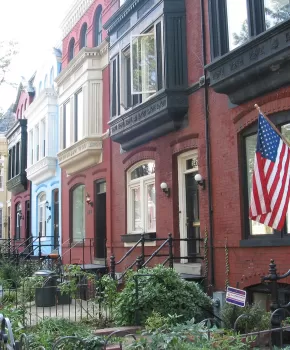
Post-war Washington experienced substantial expansion, eventually absorbing nearby Georgetown and surrounding rural areas beyond L’Enfant’s original plans. The initial boundary of Washington City was Florida Avenue, originally called Boundary Street. The first neighborhoods were those that grew up around the Capitol (Capitol Hill), the Center Market (Downtown) and the White House (Lafayette Square). The expansion of streetcar lines in the mid-19th century spurred the creation of new suburbs.
In 1901, the city proposed the McMillan Plan, which set out to fully complete L’Enfant’s original designs. This included a redesign and expansion of the National Mall, now the crown jewel of DC. The city continued to expand and develop during the rest of the 20th century, though it suffered riots and civil unrest in the ‘60s and ‘70s. Many residents left inner city areas for the suburbs. Today, these downtown areas have undergone an urban renaissance.
Though a capital city, it is ironic that residents of DC lack full self-governance. Representation in Congress is limited to a non-voting delegate to the House of Representatives and a shadow senator. In 1964, Washingtonians were first allowed to vote in Presidential elections; the city was allowed to elect its own mayor only in 1973.
As America celebrates its 250th birthday, its nation's capital shines brightly as an international melting pot with its own distinct identity and culture. The city's strong Black history and heritage and its reputation as one of the country's most LGBTQ+-friendly cities only add to its welcoming vibe. In fact, DC recognized same-sex marriage in 2010 before the Supreme Court ruled that it was a right in 2015.
After more than 200 years as the nation’s capital, DC has developed into a complex and layered city with distinctive character: a town for locals, an international center of power and an amazing place to visit.
Today, you can have the best of both worlds by delving into the nation’s past with a visit to the National Mall and museums or adventuring into very modern, exciting neighborhoods.